ping #51 · tiny delights
The Music Box as a Thread Between Two Chapters
A giggle and a music box close out Chapter II of HAUNTED, and in Chapter III the music box stutters. A ping about a sound that ties chapters together.
In a lot of games, a chapter transition is just a cut. A loading screen, a title card, and off you go. HAUNTED: Are You Alone? ties two of its chapters together with a sound instead. A music box starts playing at the end of Chapter II, and by Chapter III it’s still there — just not quite healthy anymore.
The end of “The Hands”
Chapter II is loud. Ghostly hands pound on your walls, arms break through, waves of 3, 5 and 8 arms come at you, and one last one drops from the ceiling. Then, per the game description: silence. A tiny giggle behind you. And a music box starts to play.
After all that noise, it’s a remarkably quiet finish. No triumph, no fanfare. Just a small, innocent sound. And that’s exactly why it’s creepy — because it’s so innocent.
The start of “The Doll”
Chapter III picks up right where the sound came from. The girl’s porcelain doll sits on your floor, next to the music box. The witch is inside it now. The doll turns toward you with a grinding creak and invites you to play. Then she stands up and copies your every move.
So the music box isn’t just a transition sound. It’s an object in the room, and it belongs to a character. If you caught where the melody was coming from at the end of Chapter II, you know exactly where to look at the start of Chapter III.
When the melody catches
The best detail comes mid-chapter. While the doll mirrors your movements, the music box stutters and catches. At the same time, the copy glitches into wrong poses, and then the doll freezes. You move, she doesn’t anymore. Shortly after, the lights go out.
That makes the music box a kind of mood meter. As long as it plays cleanly, the game is still a game. When it catches, the situation tips. The game doesn’t tell you that with an on-screen prompt — it tells you with a sound everyone knows: a music box whose mechanism isn’t running smoothly anymore.
Why a music box?
We asked ourselves why this particular object fits so well. A few thoughts from our sketchbook:
- It belongs to kids. Per its description, HAUNTED runs on creepy children’s voices and a little girl on the phone. The music box fits that world.
- It’s mechanical. A music box can slow down, stall, catch. That makes it the ideal instrument for a shift in mood.
- It’s quiet. After the noise of Chapter II, a quiet sound is a stronger contrast than a loud one.
- It has a place. Because sound in HAUNTED comes from real positions in the room, you can locate the music box.
One object, many roles
The music box is a good example of how HAUNTED tells a lot with just a few objects. First it’s a sound, then an object next to the doll, then a mood meter. Play the game with that eye and you’ll notice other things doing double duty too: the rotary phone from the prologue comes back in the epilogue in the same spot, and a mirror is already waiting at the end of Chapter V for the next chapter. Recurring objects like these give a short story a sturdy frame.
Three tiny delights
- The giggle before it. A tiny sound announces the next one.
- The music box next to the doll. The sound gets an owner.
- The catching. A glitch as the signal that everything’s about to tip.
What we’d steal for our own projects
- Carry a sound across a chapter break. When a tone starts at the end and keeps going at the start, the transition feels like a breath.
- Mechanical sounds as a mood meter. What runs smoothly soothes. What catches unsettles.
- Quiet after loud. After a peak, a small tone often lands harder than a big one.
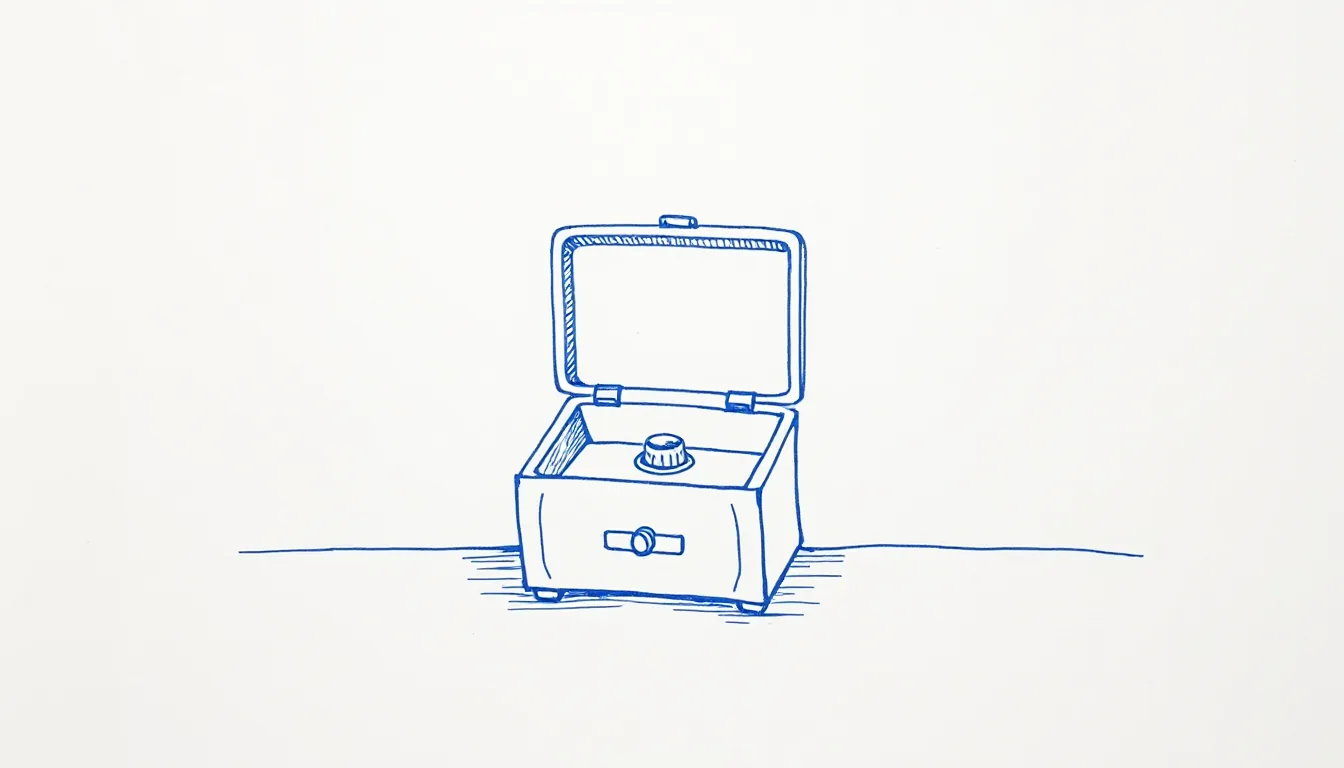
For our doodle, we drew a little music box with a crank on an empty floor. That’s all it takes to switch the melody on in your head.
HAUNTED: Are You Alone? is a mixed-reality horror game for Meta Quest, PEGI 18 and not suitable for children. Per the game description, the story runs about 25 to 35 minutes, plus three endless arcade modes. More info is on the store page in the Meta Horizon Store.