ping #11 · tiny delights
Music That Ducks: The Polite Art of Stepping Back
MindIsland's optional background music "ducks under the words." A ping about a sound detail you barely notice and would still miss.
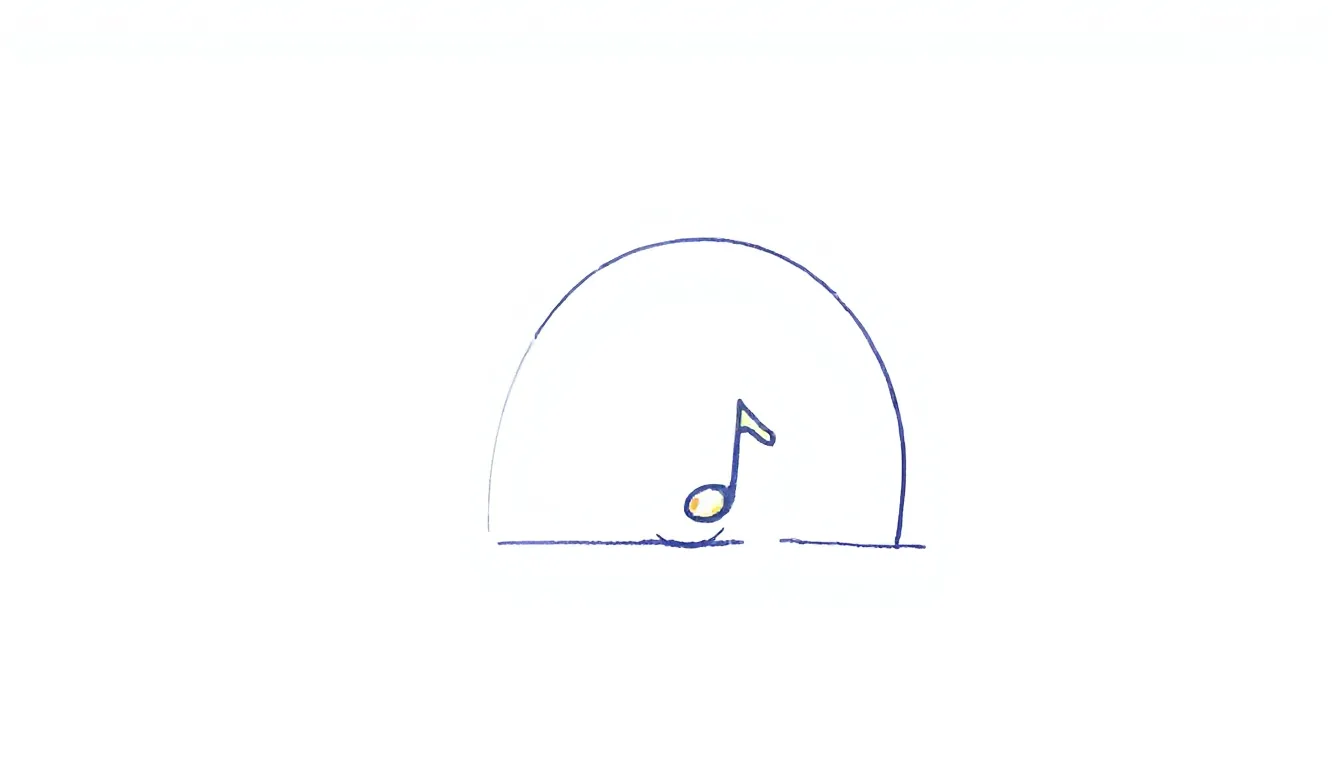
There’s a half-sentence about background music on the MindIsland website that’s easy to skim right past. The optional, mood-based music is meant to “gently duck under the words.” We read that and immediately pictured a cat sliding under a table so it doesn’t get in anyone’s way.
That little word “duck” describes a technique you know from radio and podcasts. The moment someone speaks, the music gets quieter. When the voice stops, it comes back. Sounds mundane. In a meditation, it’s anything but.
Why ducking matters in a meditation
A guided meditation has two layers. On top, the voice guiding you. Underneath, if you turn it on, a bed of sound. Both of them want something. The voice wants to be understood. The music wants to carry you. When both are equally loud, they fight each other, and you’re sitting in the middle having to work at it.
Effort is pretty much the last thing you want while meditating. If you have to concentrate on listening, you’re not with your breath. That’s why we find the ducking so smart. It takes a task off your hands that you didn’t even know you had. No more fiddling with the volume, no more straining your ears. The music gets out of the way on its own.
A detail you only notice when it’s gone
Ducking is one of those things you only notice when it’s missing. Everyone’s seen videos where the music drowns out the speaker. You turn it up, now the music’s too loud, you turn it down, now you can’t understand a thing. In a well-mixed piece, that never happens, and nobody ever praises it.
So we’re glad MindIsland calls this out explicitly. Anyone who writes that down has thought about it. And it fits the rest of the app: the voices are described as calm and warm, sessions run a short three, five, or ten minutes, and the background music is optional. If you’d rather hear just the voice, you simply leave it off.
The music as a roommate
In our sketchbook, we drew the whole thing as two characters. The voice is a little person standing up front on a stage. The music is a second figure humming in the background. Every time the front figure opens their mouth, the back one bends its knees a little. The moment the front one goes quiet, the back one straightens up again.
That drawing also explains why the detail feels so friendly. Ducking is a form of consideration. The music isn’t the star, but it isn’t silent either. It fills the pauses between sentences so the silence doesn’t suddenly feel empty, and it steps back as soon as something needs to be said.
A glance at radio
Radio hosts have been talking over playing music for decades, and someone at the mixing desk pulls the fader down while they do it. These days, automatic settings often handle it. So the tool isn’t new — what’s new is where it shows up. In an app meant to help you settle down, a radio trick suddenly becomes a small gesture of care. We like that kind of migration, ideas hopping from one craft into another.
Three tiny delights
- The verb “duck.” A single word that turns a whole mixing-desk technique into an image.
- Optional means optional. The music is an offer, not a required part of the session.
- Mood-based. According to the website, the background music is matched to the mood instead of being the same loop every time.
What we’d steal for our own projects
- Think in layers, hierarchically. When two things ask for attention at once, one of them has to give. That goes for sound the same way it goes for layouts.
- Describe consideration as a feature. The fact that something makes room is a quality worth mentioning.
- Don’t leave silence empty, but don’t stuff it either. A quiet carpet underneath is often enough.
We can’t describe here how each individual sound bed sounds, since that depends on the mood and the session. But the principle holds, and it’s one of those small things that turn a recording into a pleasant listen. You can find out more about the app at mindisland.app. MindIsland is meant for relaxation and reflection, not as therapy.