ping #12 · design notes
Never Longer Than 1.5 Seconds: Why You Barely Get to See the Witch
The witch in HAUNTED glitches like a broken video signal and never stays visible for more than about 1.5 seconds. A design note on showing less.
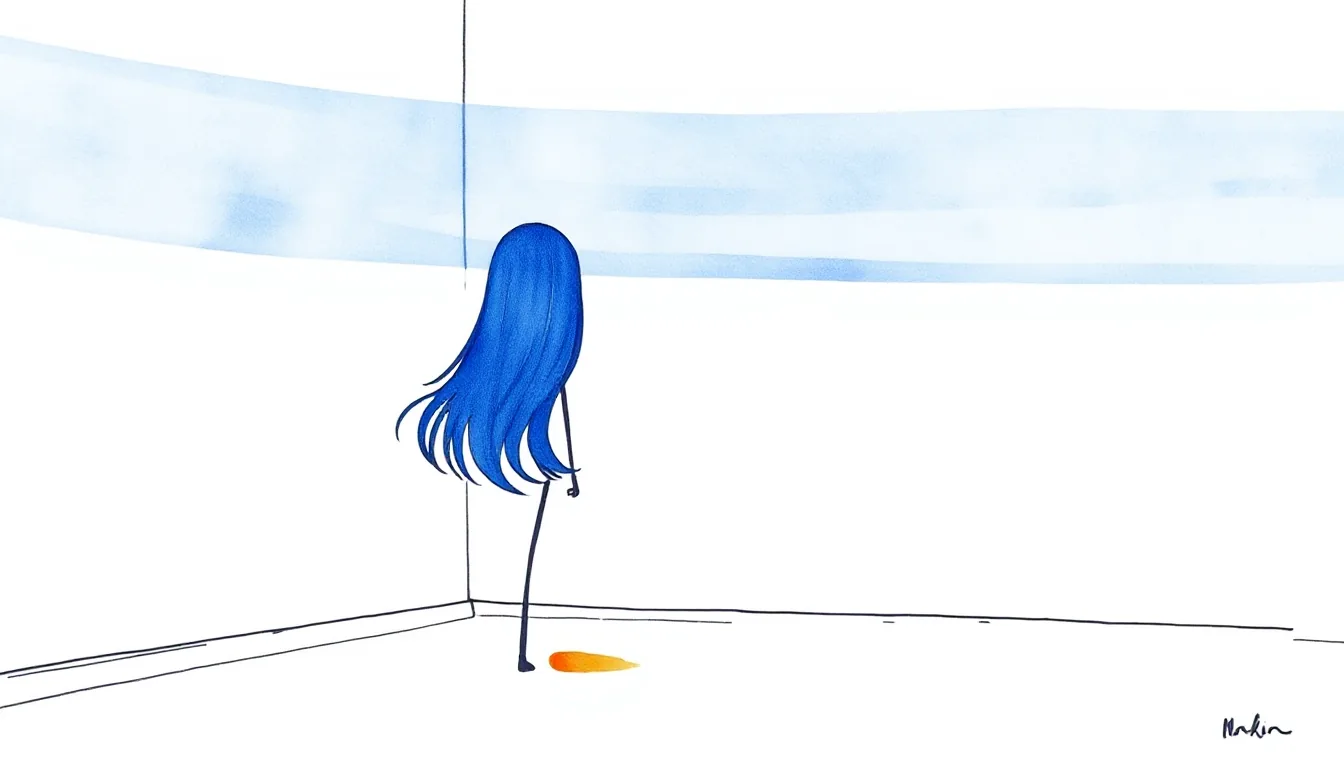
There’s an old rule in horror: the monster behind the door is scarier than the monster in front of it. HAUNTED: Are You Alone? turns that rule into a number. The witch, the game’s first major antagonist, is according to the game description never visible for more than about 1.5 seconds.
A broken video signal
At the start of Chapter I, the witch stands in the corner farthest from you. Head lowered, wet black hair. And she glitches like a broken video signal. She’s there, then she flickers, then she’s a bit farther along, then gone again.
That’s a smart choice for a mixed reality game. Your room is visible through passthrough and feels stable and familiar. The witch, by contrast, looks like she doesn’t belong in that picture, like she’s being jammed in from somewhere outside it. The glitch isn’t just an effect — it tells you something: here’s a thing that doesn’t quite fit into your world.
Why less makes more fear
We got to thinking about why the 1.5-second limit works so well. Three reasons:
- The brain fills in the gaps. When you only see fragments, you complete the picture yourself. And your own imagination is usually worse than any model.
- You can’t get used to it. A monster you can stare at for a long time eventually becomes an object. A monster that only ever flashes briefly stays foreign.
- Every sighting becomes an event. When the witch shows up, it’s a little jolt every time, because you don’t know how long she’ll stay or where she’ll be next.
The game uses this idea as early as the prologue. If you turn around during the phone call despite the warning, you catch only a split second of her, glitching. That’s the first contact, and it’s deliberately too short to really make anything out.
See briefly, feel for a long time
What’s interesting is how that brief glance plays with the core mechanic of Chapter I. The chapter is called “Don’t Look.” Look away, and the witch reappears closer. Hold eye contact too long, and her head snaps up and she screams. The game reads your head direction for this, not eye tracking.
Which means: you don’t actually want to look at her, but you need to know where she is. The 1.5 seconds are the perfect frame for that. They’re just enough to locate her, but not enough to feel safe.
Sketching the glitch
For our sketchbook, we tried to capture the glitch look in ink. It works surprisingly well with a few simple rules:
- One silhouette, sliced horizontally. Three or four strips, each shifted a little to the side.
- Long hair as vertical strokes. That reconnects the strips, but not quite.
- One strip missing. An empty gap in the middle of the figure is creepier than any line.
- One accent color at the edge. A thin colored offset on one edge is enough to say “signal interference.”
The result is a figure you can draw in two minutes that still nails exactly the feeling: something’s there, but it’s not quite there.
Three tiny delights
- A concrete limit. 1.5 seconds is a design decision you can almost measure.
- The glitch as storytelling. The interference in the image says she doesn’t belong here.
- The split second in the prologue. The first look is deliberately too short.
What we’d steal for our own projects
- Set a visibility rule. How long is the player allowed to see the threatening thing? A fixed upper limit forces discipline.
- Interference instead of detail. A glitch can create more unease than an elaborately modeled grimace.
- Match the mechanic to the look. If the enemy flickers, the game should also revolve around looking and looking away.
Before you try it
HAUNTED is PEGI 18 and, per its content warning, includes sudden loud noises, flashing lights and intense jump scares. It’s not suitable for children, pregnant people, or anyone with epilepsy, heart conditions or anxiety disorders. More info is on the store page in the Meta Horizon Store.