ping #16 · tiny delights
The Little Pause in the Middle: The Comma in the Opening Breath
Every MindIsland session starts with 4 seconds in, a short pause, and 6 seconds out. We zoom in on the pause, the most unassuming part of it all.
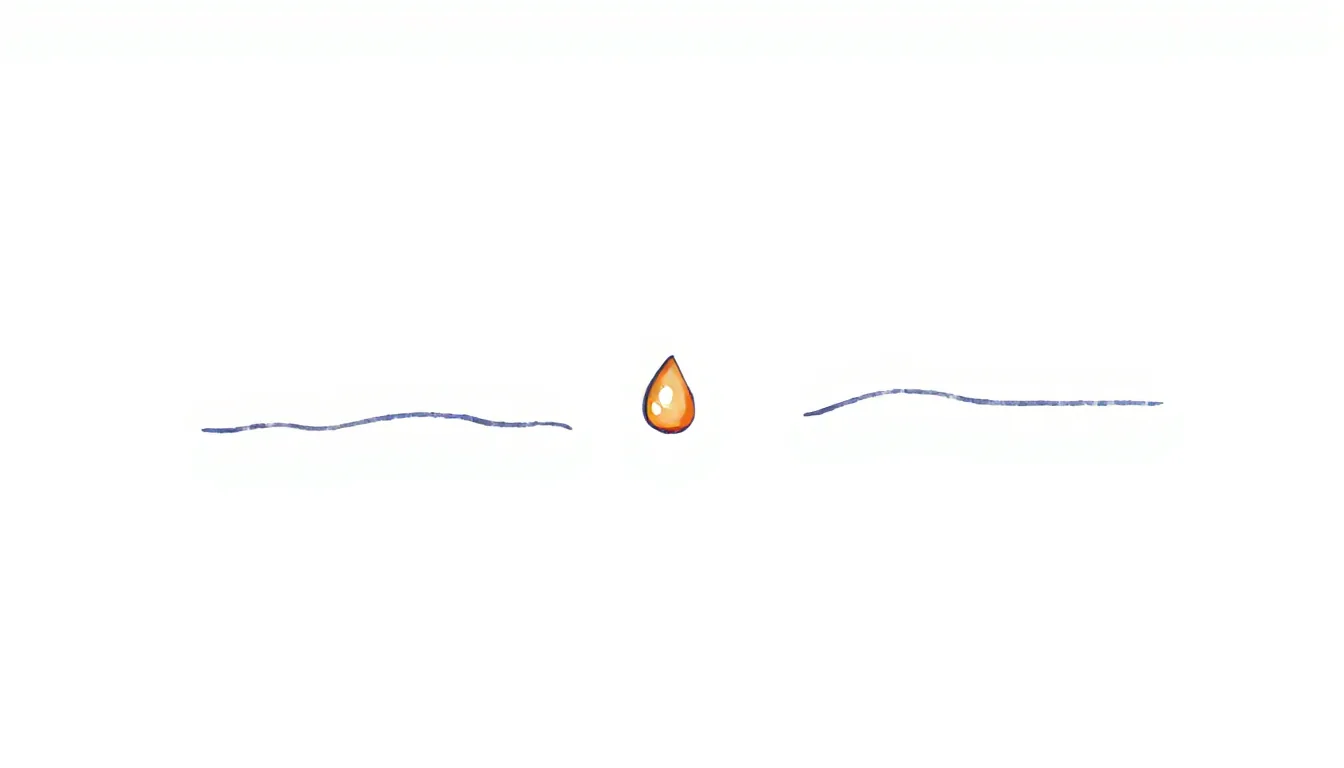
Most people who talk about the opening breath in MindIsland talk about the numbers. Four seconds in, six seconds out. That’s also the part that’s easy to remember. But the website lists a third element too, and that’s what kept us busy this week more than the two numbers: “Four seconds in, a short pause, six seconds out. That’s how every session begins.”
A short pause. No number, no seconds, just a little beat of stillness between two movements. In our sketchbook it looks like a comma in the middle of a sentence. And that comma is exactly what we want to look at in this ping.
A breath as a sentence
If you read a breath as a sentence, the inhale is the beginning and the exhale is the end. Without a pause it’s one long word that tips from one direction into the other without taking a breath. With the pause, the sentence gets structure. You notice that you’ve reached the top before it heads back down.
We tried it with a pen. A line that rises for four squares, then a tiny flat stretch, then falls for six squares. That flat stretch is barely visible. Even so, it changes the whole drawing. Without it, the curve looks like a sharp peak. With it, it looks like a hill you’re allowed to stand on for a moment.
Why we like the comma
The rest of a MindIsland session has a lot to do. According to the official descriptions, it’s first about acknowledging the problem, then about gently reframing it, and only then about breathing and silence. That’s a whole little arc with content. Before that arc begins stands the opening breath, and in the middle of that breath stands the pause.
We like that the pause has no job. On the inhale you’re supposed to inhale, on the exhale you’re supposed to exhale. During the pause you’re supposed to do nothing. It’s the only spot in the entire sequence where truly no instruction is waiting. For a moment you’re neither at the beginning nor at the end of anything.
And it’s deliberately vague. With “short,” everyone gets to decide for themselves how short. If you’re nervous right now, you might make it tiny. If you’re already calmer, you stay up there one heartbeat longer. A fixed number of seconds would turn it into a test. The word “short” turns it into an invitation.
Pauses in other things we love
The pause in the breath reminds us of other little standstills that often make design better:
- The half-second moment before an animation. Many interfaces wait a beat before something pops up. Without that delay, everything feels frantic.
- The blank spread in a zine. Sometimes the best page is one with almost nothing on it.
- The breath before the chorus. Music lives on the beat where nothing happens at all.
In all these cases the pause isn’t a mistake and isn’t a loading bar. It’s part of the form. That’s exactly how we read the “short pause” on the MindIsland website too.
A small note
A breathing exercise like this is meant for relaxing and taking a moment. MindIsland itself describes itself as an app for relaxation and personal reflection, not as a medical product. If you feel uncomfortable or dizzy while breathing, just go back to breathing normally. The pause is an offer, not a must.
Three tiny delights
- The word “short” instead of a number. It leaves room to play, where two fixed numbers already give enough of a frame.
- The pause comes at the start of every session. Whether three, five, or ten minutes, the comma always comes first.
- It fits any posture. Whether in a chair, on the floor, lying down, or standing on the train: staying up there for a moment works anywhere.
What we’d steal for our own projects
- Name the transitions. If you’re explaining a sequence, you should mention the spots in between too. A “short pause” makes the sequence more honest.
- Vagueness as kindness. Not every value needs a number. Sometimes “a little” is the nicest instruction.
- Draw the empty spot. In our sketches we now mark the pauses too, not just the movements.
If you want to try the opening breath yourself, the MindIsland website has the invitation to join in for one breath. We mostly kept an eye on the comma.