ping #57 · design notes
A Game With No Instructions: The Doll That Copies Every Move You Make
In Chapter III of HAUNTED, a porcelain doll copies your every move with no on-screen prompt at all. A design note on mechanics you discover for yourself.
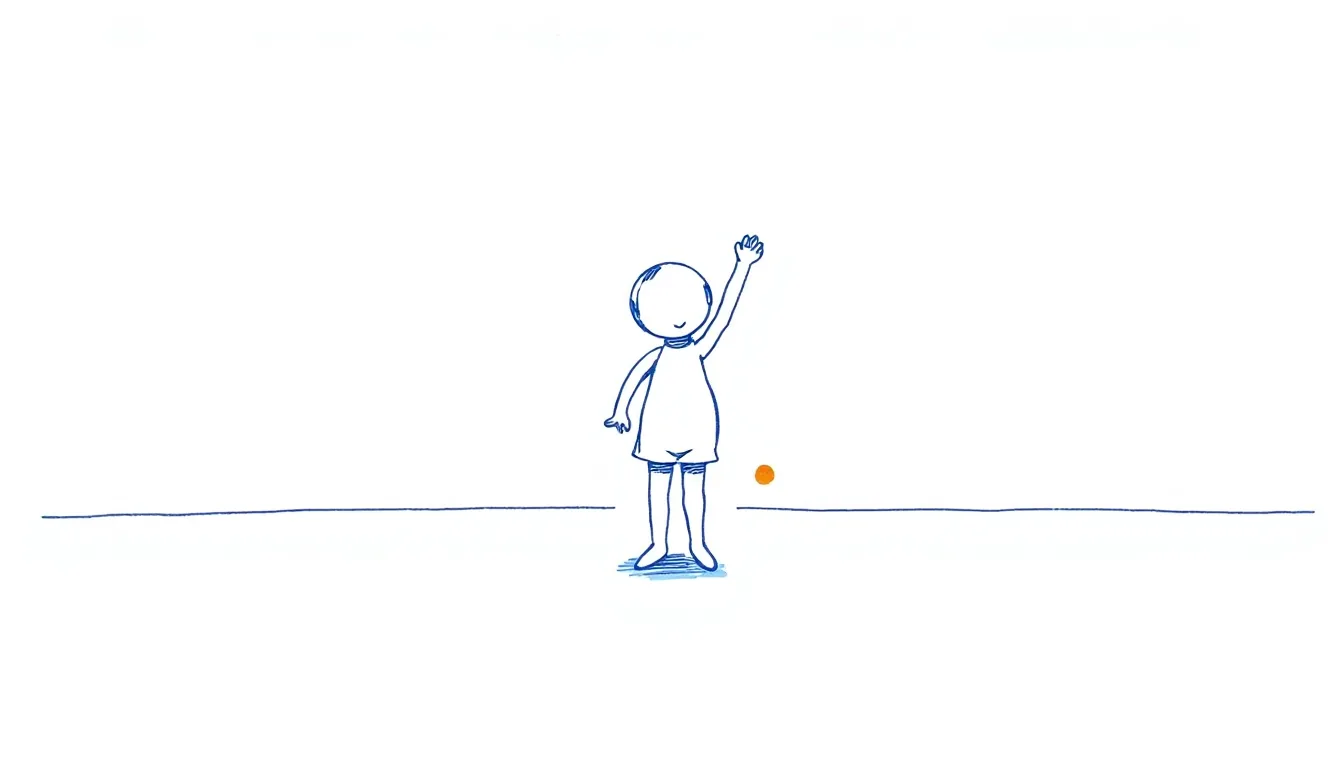
There’s a moment in Chapter III of HAUNTED: Are You Alone? where you just raise your hand. Not because the game asks you to, but because you want to see what happens. And the doll in front of you raises its hand too. That’s the whole trick, and it’s great.
The doll
Chapter III is called “The Doll.” The girl’s porcelain doll sits on your floor, next to a music box. The witch is inside it now. The doll turns toward you with a creak and invites you to play. Then it stands up and copies every move you make: raise a hand, wave, crouch, tilt your head.
The key detail is in the store description, in one short sentence: there are no on-screen prompts. Nobody tells you to wave. Nobody explains that the doll is mirroring you. You work it out on your own.
Why no instructions is a good thing
Lots of games pop up a window when a new mechanic appears: “Move your hand to…” That’s helpful, but it tears the moment in half. HAUNTED deliberately skips it here, and that pays off in a few ways:
- The discovery is yours. The first time you notice the doll is playing along, it feels like you figured something out.
- The tension holds. No text breaks the atmosphere. You’re standing in your room in front of a doll, and that’s all.
- The mechanic explains itself. Everyone knows mirroring, from childhood games to the bathroom mirror. There’s nothing to learn, only something to try.
Your body as a question
What we like most: the mechanic only works because your whole body is the input. HAUNTED can be played with either hand tracking or Touch controllers, and the doll responds to real movement. You actually crouch. You actually tilt your head.
That turns the mechanic into a kind of conversation. You ask a question with your body (“Can you do this too?”), and the doll answers. It’s a very old form of interaction, older than any game, and that’s exactly why it needs no explanation.
And then it tips
A mirroring game on its own would just be creepy-cute. HAUNTED uses it as a setup. The music box stutters and skips, the copy glitches into wrong poses, and then the doll freezes. You move, it doesn’t.
That break is what makes the earlier part land so hard. First you learn by trying things yourself that the doll follows you. Then it stops. And the feeling that was control a second ago flips straight into unease. After that the lights go out, and the chapter turns into a fight with a baseball bat. How exactly, we’re not telling here.
Why a doll, of all things
A doll is the obvious choice for this mechanic. It has human proportions but no life of its own, and that’s exactly why every movement registers right away. A monster that mimics you would just be threatening. A child’s doll that mimics you is almost playful at first. That brief moment of playfulness makes the later break that much stronger.
Three tiny delights
- The first test. Raising your hand and seeing the doll do it too.
- The crouch. A move you rarely make in your living room, and here you suddenly share it with a doll.
- The freeze. The moment the rule breaks, the one you just taught yourself.
What we’d steal for our own projects
- Teach mechanics through reaction. When the world answers an action, you often don’t need text.
- Lean on familiar games. Mirroring, hide-and-seek, tag: childhood games bring their own rules with them.
- Break a rule you taught. Build trust first, then flip the expectation. That’s tension in two steps.
For our doodle we drew a little porcelain doll with one arm raised. A single arm says: I just copied something.
A quick safety note
In Chapter III you crouch, tilt your head, and later swing a bat. Clear your play space first. HAUNTED is listed for room-scale and standing, and it never moves the camera for you. The game is PEGI 18 and not suitable for children. More info is on the store page in the Meta Horizon Store.