ping #58 · tiny delights
Petting Cyan: The Permitted Touch in Laser Thief
Move slowly enough through a cyan laser in Laser Thief and all you trigger is a sparkling "graze." A game that rewards slowness.
In most movement games, the fastest player wins. In Laser Thief, there’s one color where the opposite is true. You’re allowed to touch cyan lasers, as long as you do it slowly. The game calls this moment a “graze,” and it sparkles.
The rule in one sentence
According to the studio, cyan is the motion sensor among the eight laser colors. It only trips if the body part touching it is moving faster than 0.45 meters per second. Touch it more slowly and there’s no hit, just a harmless brush with a little sparkle and a sound.
The laser lexicon in the game puts it plainly: “Motion sensor: it only trips if you pass through quickly. Go slow.”
0.45 meters per second, by the way, is pretty slow. A leisurely stroll is noticeably faster. So you have to brake on purpose, almost like slow motion.
Learning with a curtain
The fourth training lesson is called “CYAN = SLOW.” A curtain of eleven cyan beams stands between you and the loot. The task is a full heist, just a slow one. The feedback is wonderfully terse: “So stealthy!” when it works, and “Too fast!” when it doesn’t.
In the story, cyan is introduced in level 2-07, “GHOST WEB,” in the Crystal Museum: “Cyan beams only feel speed. Glide through slowly.” Later, hints show up that you’d almost want to hang on your wall: “Lattice walls, cyan veils. Slow is smooth.” And in the final world: “Cyan only bites if you rush. Move like glass.”
Why that’s so rare
Laser games usually run on dodging. A beam is a boundary, and touching it is failure. Cyan breaks that rule. It turns touch into something permitted, even beautiful, as long as you’re mindful. The sparkle on a graze is a small reward for patience.
What’s also exciting is how cyan gets along with other elements. In level 4-13, “RADIATION FIELD,” the hint reads: “Fast under the red, slow through the cyan.” So you have to play two tempos in the same room, ducking fast under a red scanner bar and then braking immediately. And in the gadget levels there are security cameras that also punish movement. There the threshold is even stricter: you only count as “still” below 0.12 meters per second.
The solver that checks whether a path is possible before each level never counts cyan as blocking, by the way. So a cyan curtain is never a wall, always a door you have to open slowly.
A thought on movement
Slow movement in a room takes balance and space. If you’re sliding through a curtain in slow motion, you should be standing securely with no furniture within reach. The game is designed for a 3 × 3 meter area, and short rounds are more pleasant than long ones anyway.
Slow motion as a feeling
There’s a second reason cyan is so special. It changes how your own body feels in the game. With red, you think in distances: how much room do I have? With cyan, you think in speed: how steady is my hand, how slow is my step? That’s almost a little mindfulness exercise in the middle of a heist, without the game ever having to call it that. Glide through a cyan curtain and you suddenly start listening to your own tempo.
Three tiny delights
- A sparkle instead of an alarm. The permitted touch has its own little reward.
- “Move like glass.” A hint that sounds more like a dance lesson than a game rule.
- Two tempos in one room. Fast under red, slow through cyan.
What we’d steal for our own projects
- A rule that rewards patience. Not every challenge has to be solved with speed.
- Differentiate touch. Whether something is dangerous can depend on how you touch it.
- Keep the reward small and sensual. A sparkle and a sound are plenty.
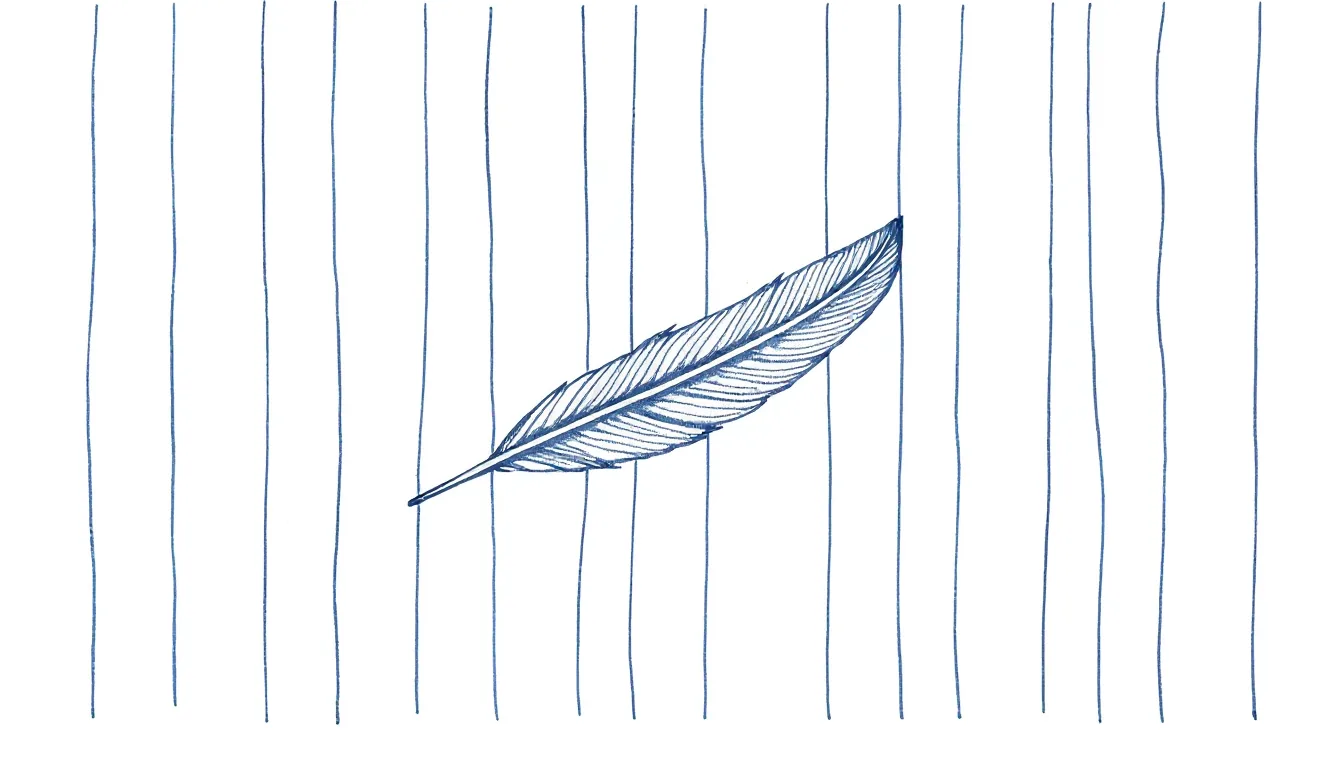
Our doodle: five vertical strokes like a curtain, and right in the middle a feather with two tiny stars. Laser Thief is available in the Meta Horizon Store.