ping #28 · tiny delights
Nine Centimeters of Hero: Just How Small Is Our Tank, Really?
The tank in Tank Avenger is about nine centimeters long. We break down the size of the cell, block and floor tile, and sketch out the scale.
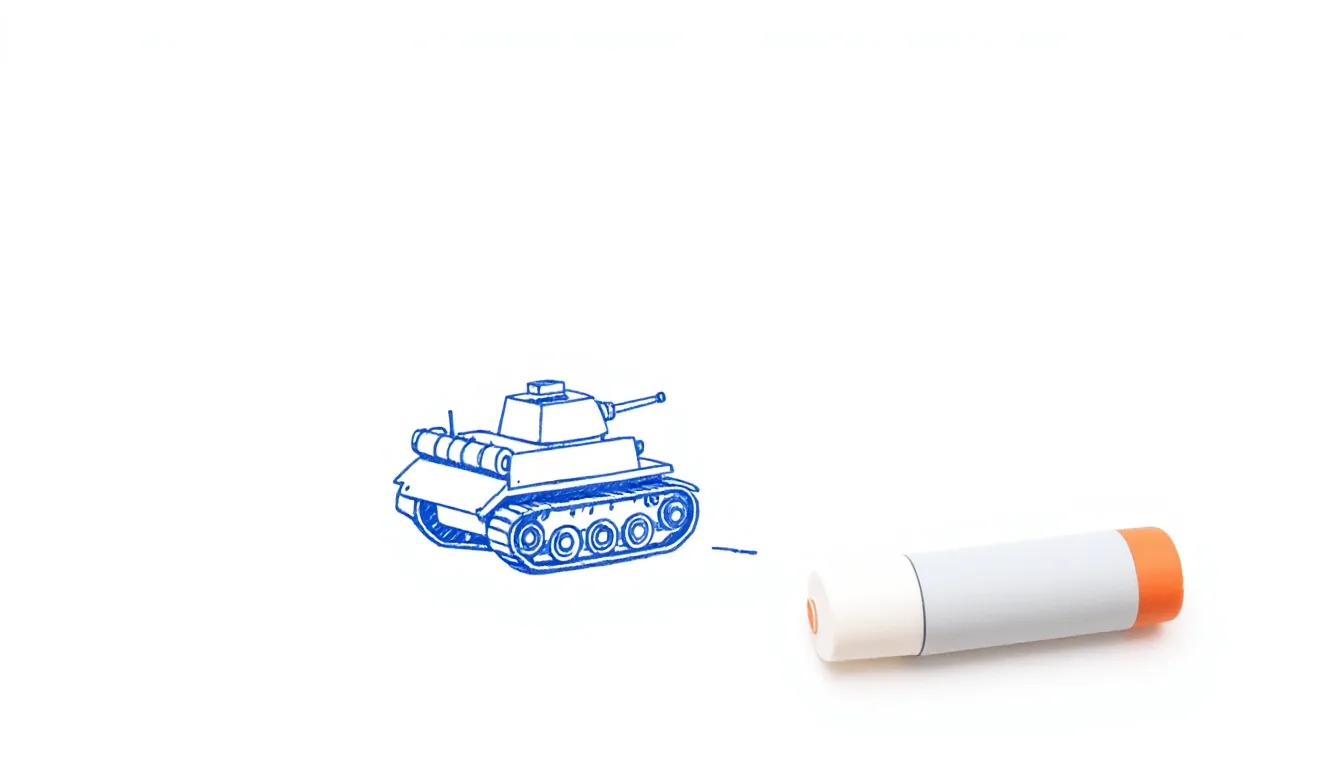
Pick up an eraser from your desk. Set a pen next to it. Somewhere between those two things is the size of the hero in Tank Avenger – Mixed Reality: our tank is roughly nine centimeters long. That’s smaller than most smartphones and about as long as a finger. And the whole game is built on that scale.
The three numbers behind the miniature
The game description lists three measurements that together form the grid of the world:
| Unit | Size | What it’s for |
|---|---|---|
| Cell | 5 cm | The base grid; speeds are measured in cells per second |
| Block | 10 cm (2 × 2 cells, two cells high) | Walls, crates, soft terrain |
| Floor tile | 25 cm (5 × 5 cells) | The area we paint in during setup |
So a tank is just under two cells long. A wall is about as tall as a tank is long. And a floor tile, which we toggle on or off with the controller during setup, is about as wide as two and a half tanks lined up nose to tail.
How that feels on the floor
A little math helps you picture it. Most maps are 50 × 50 cells, so 2.5 × 2.5 meters. A few early levels are a bit smaller at 40 × 40 cells, so 2 × 2 meters. That matches the recommendation on the studio’s website: about 2 × 2 meters of free floor.
The minimum to keep playing is 24 lit tiles, so 1.5 square meters, plus a free area of at least 0.6 × 0.6 meters. That free area fits exactly twelve cells side by side, or six tanks nose to tail. The main fortress lands on the largest free rectangle. Shrink the space and the battle gets tighter. The cells themselves only shrink if a fortress wouldn’t fit otherwise.
Our tank drives six cells per second, so about 30 centimeters per second. That’s roughly a comfortable crawl across the carpet.
Why the scale works so well
Nine centimeters is toy size. Everyone knows model cars or little figures at that scale. That makes the world instantly readable: we don’t have to learn how big a tank is, we know it from the playroom.
At the same time, the scale is small enough that an entire fortress fits on a patch of living room floor, and big enough that you can see details when you crouch down. We walk around the battlefield instead of steering a camera. The scale is what makes that possible.
A scale doodle to copy
For anyone with a sketchbook handy, here’s our guide:
- Draw a square 5 boxes on a side on graph paper. That’s a floor tile.
- Mentally divide it into cells: each box is one cell.
- Color in a block of 2 × 2 boxes in one corner. That’s a wall.
- Draw a tank next to it, just under two boxes long.
- Put a real eraser beside it for comparison.
Just like that, you’ve got the scale of the whole world on one page.
And the biggest thing in the room?
The biggest tank in the game is the boss of the Tank Hunt levels, the Juggernaut. It’s a heavy version scaled up by 1.35 times, so roughly twelve centimeters long if you start from our tank. Only the attack helicopters are bigger, circling us just below head height.
What we’d steal for our own projects
- A fixed grid. Three simple numbers (5, 10, 25) explain the entire geometry.
- Toy size as a language. A size everyone knows from real life needs no explanation.
- Stay flexible. The battle adapts to the space instead of demanding a fixed room size.
Small hero, real room
As small as the tank is, the space around it is real. Every time you start, the game shows a safety overview with five rules, including: keep nothing on the floor and stay on the lit tiles. Especially when you’re crouching down to the details, it’s worth a look at your surroundings.
You can read more about the game in the Meta Horizon Store.