ping #27 · tiny delights
Slow Motion at Chest Height: The First Swat on a Scout
A Scout jumps at your face, hangs in slow motion in front of your chest, and Sozo just says: SWAT IT! A tutorial without text boxes.
When something jumps at your face, you don’t think. You swat it. Sozo – Tower Defense builds an entire lesson out of that exact reflex. Your first contact with an enemy isn’t a hint window, it’s a jump, a slow-motion moment, and a swat. We took a closer look at that moment.
The jump
According to the studio’s game guide, it happens in the fourth and fifth beat of the intro. The Core Crystal has just grown out of your floor when it pulses red, things rumble, and the crack of light in your wall tears open into a real rift. Malgrath’s voice: “There you are, little program.” ECHO hides behind the crystal. A Scout crawls out, hisses, and jumps at your face.
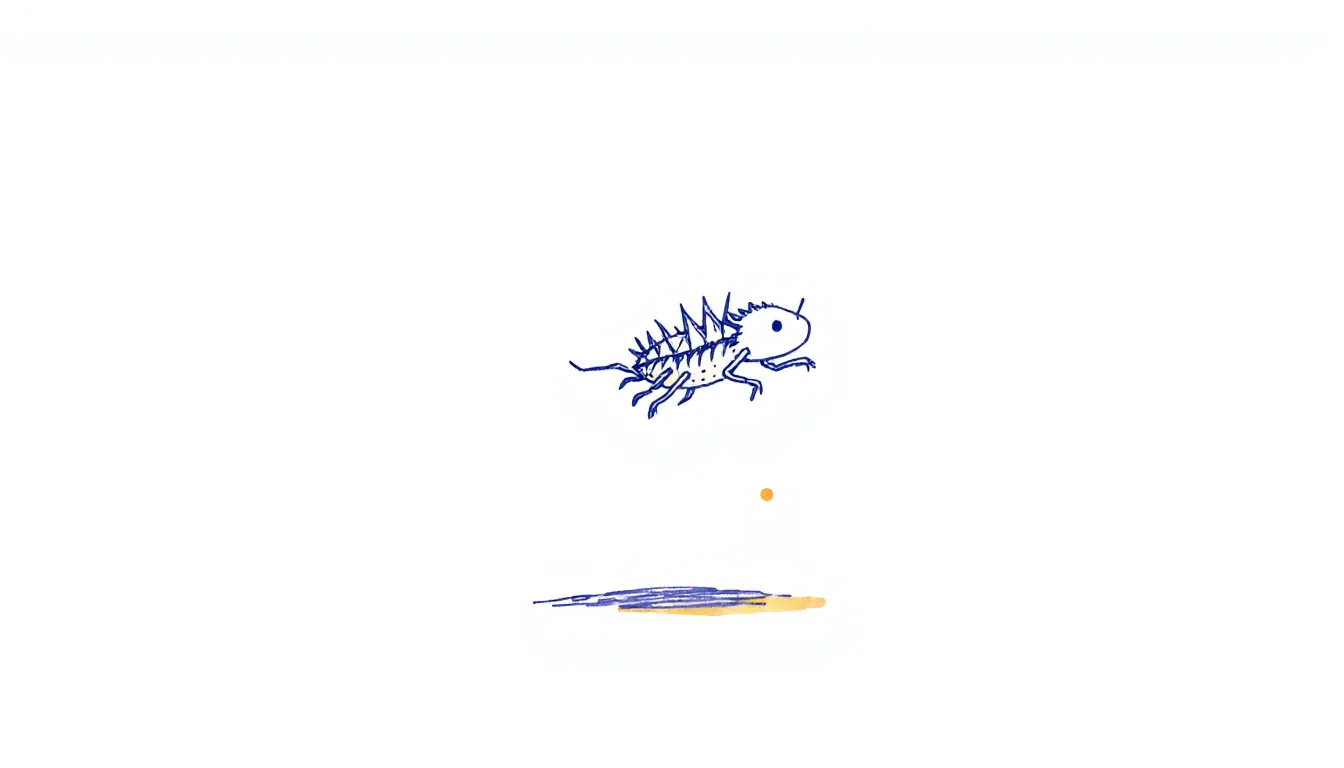
Then time almost freezes. The Scout hangs in slow motion in the air, right in front of your chest. On the display: “SWAT IT!”, and below it “HIT IT WITH YOUR HAND”.
The swat
You swing. What comes next, the guide describes as a little feedback package: hit-stop, a flash of light, and haptics, plus the words “SMASHED!” and from ECHO: “Nice swing, Keeper!”
Each of these elements has a job:
- The hit-stop is a tiny freeze at the moment of impact. Fighting games have used it for decades because it gives a hit weight. The eye registers: something happened here.
- The flash marks the point of contact.
- The haptics give your arm an answer. (With bare hands there’s naturally no vibration, per the guide; with controllers there is.)
- The praise closes the loop emotionally. Not “task complete,” but a compliment, with a name: Keeper.
Why the slow motion is so clever
A Scout that jumps at you at normal speed would be gone in half a second. A lot of people would flinch, but not connect. The slow motion takes the pressure off without losing the scare. You get the adrenaline moment of the jump and then enough time to react on purpose.
And it places the target exactly where your hand wants to go anyway: in front of your chest. Not up in the corner, not on the floor. Anyone who’s tried in VR to hit a target that’s too far away knows how much that placement matters.
A tutorial without text boxes
What’s remarkable is what doesn’t happen here. There’s no explanation like “Enemies can be swatted with your hand. Swing your arm at sufficient speed.” All of that is true, and Sozo even has precise rules for it later: swats count above a certain speed, and flying enemies need several full hits. But for the first contact, one two-word sentence and a situation where the right motion is obvious are enough.
The principle has a name in game development: teaching through action. The mechanic is experienced before it’s explained. Later in the game, when flyers come out of a hole high up in the wall and attack your towers, you already know what to do. Your hand remembers.
One safety detail still belongs here: if you’re swinging, you should have room around you. Sozo plays in a real room, so before you start it’s worth a quick look at lamps, shelves, and roommates within reach.
And what if you never swing at all? Then per the guide you first get a stronger hint, and in the end ECHO does a body slam on the Scout. Nobody gets stuck here either.
Three tiny delights
- The hiss before the jump. A short announcement so the scare stays fair.
- The chest height. The target hangs right where every hand can reach it.
- “Nice swing, Keeper!” Praise for the swing, not just the result.
What we’d steal for our own projects
Look in your project for the action people would make instinctively, and build the first lesson around it. Then give them a moment of slow motion: an instant where the world waits a beat so the motion can land. Whether that’s a slowed animation, a pausing video, or just a really big button doesn’t matter. The main thing is that the first success feels like a reflex, not a test.
In our sketchbook there’s now a little crawler hanging in midair, surrounded by motion lines. We left out the hand. You imagine that part anyway.